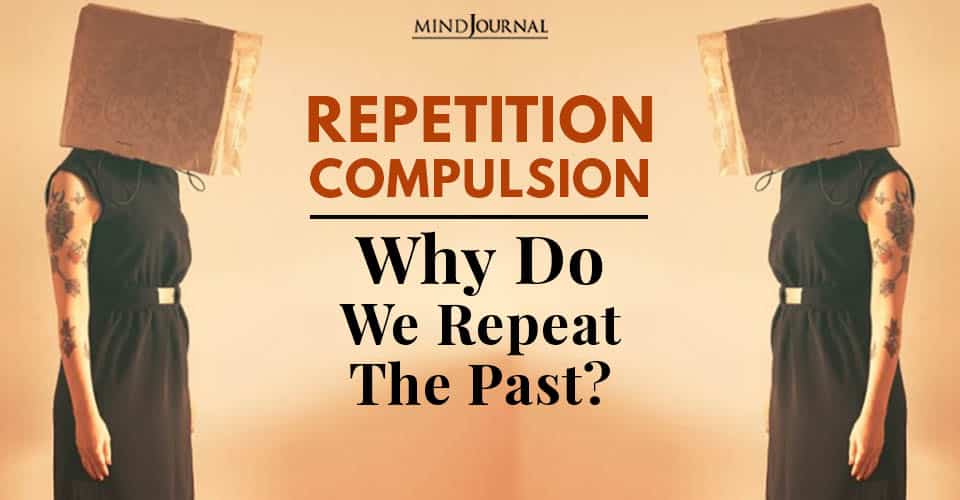
Repetition Compulsion: Why Do We Repeat The Past?

Author : Dr. Bruce Bradfield

Have you ever asked yourself, “Why does so-and-so keep going for the same type of partner even though their parents were abusive?” It may be a repetition compulsion.


What is Repetition Compulsion

This is a Freudian concept on which we seek the familiar; he describes it asthe desire to return to an earlier state of things.” It’s a neurotic defense mechanism, an attempt to rewrite our histories.

Imagine you are exposed to an abusive pattern with a primary caregiver, and at the time of exposure, you lack power. You have no control to change the situation. You might find yourself repeating the trauma and its circumstances as an adult.


For example, you may enter the repeated pattern as an adult in order to find control, to almost “repair” and “fix” the injury from early life, although not always successful. Importantly, these deeply rooted patterns can be playing out in our unconscious, and may not be repeating consciously.

The concept works well when it’s repeating positive cycles or helpful healthy behaviours; however, it runs us into difficulty when we’re repeating behaviours that lead to toxic relationships and various types of abuse. The theory according to the Freud was that this compulsion is lead by the “death drive” – perhaps that’s a topic for another day.

Related: Breaking Free Of Obsessive Compulsive Disorder (OCD)


Some theoretical understandings of this compulsion are that we return to what’s familiar in times of stress and repeat negative patterns and thoughts (rumination). We return to these patterns as a form of self-soothing because it’s more predictable to locate yourself there, even if it doesn’t work.

For example, a child can witness a parent who is abusive and the child may feel helpless, rejected and without control. In later life, the person may seek to have control in adult relationships and try to counter the rejection and receive the love that was denied in childhood. Unfortunately, the need to get this corrective experience can lead us to gravitate to dysfunction.

Cycle of destructive relationships

The need to heal our inner child often keeps us from letting that child go and we regress instead. This perpetuates the cycle of destructive relationships and we don’t reach the attachment need we were after and are left feeling more abandoned, rejected, helpless and out of control.

Related: Why Healing your Inner Child is Crucial for Self-Growth

One can end up seeking a partner to acquire the feeling of being in control and “correcting/fixing” the childhood experience; and in our attempts to receive the love that was denied, we can often deny your own feelings to achieve that love.

Abusive behavior

Another outcome can be the person repeating the behaviour they witnessed and becoming abusive towards others or to themselves (self-harm, addiction, high-risk behaviours) in order to feel a sense of control. This becomes a dangerous re-enactment of abuse.


Related: Narcissistic Abuse Syndrome: 10 Signs You’ve Experienced Narcissistic Abuse

Therapy for repetition compulsion.

Therapy can help to create a corrective emotional experience in order to feel empowered; so as to not feel compelled to re-enter this repetitive cycle. 

A helpful therapeutic process can also help you discover your relational patterns, defenses you employ as well as developing healthier coping mechanisms and find healing.

It can take time to address these dysfunctional patterns, and many therapies approach this.

Therapies such as:

  • Cognitive-Behavioural Therapy (CBT),
  • Psychodynamically Oriented Therapies,
  • Dialectical Behaviour Therapy (DBT),
  • Rational Emotive Behaviour Therapy (REBT)
  • and more recently Brain Working Recursive Therapy (BWRT) can all be helpful in this regard.

What are your thoughts?

References:


  • Dryden, W. (Ed.). (2012). Cognitive Behaviour Therapies. SAGE Publications Limited.
  • Inderbitzin, L. B., & Levy, S. T. (1998). Repetition compulsion revisited: implications for technique. The Psychoanalytic Quarterly, 67(1), 32.

Written by: DR BRUCE BRADFIELD
Originally appeared on Brucebradfield.co.za

Republished with permission.

repetitive complusion pin


Published On:

Last updated on:

Disclaimer: The informational content on The Minds Journal have been created and reviewed by qualified mental health professionals. They are intended solely for educational and self-awareness purposes and should not be used as a substitute for professional medical advice, diagnosis, or treatment. If you are experiencing emotional distress or have concerns about your mental health, please seek help from a licensed mental health professional or healthcare provider.

Leave a Comment

Today's Horoscope

Your Daily Horoscope For 4 April, 2026: Free Predictions

Daily Horoscope 4 April, 2026: Prediction For Each Zodiac Sign

Look at your daily prediction and see what the stars have in store for your love life and your future!

Latest Quizzes

How Many Circles Do You See? A Simple Test of Thinking Style

How Many Circles Do You See? Your Answer Might Reveal Narcissistic Traits! 

Take a closer look at this simple image and discover what your circle count reveals about your thinking style, perception, and attention in this fun and engaging visual test.

Latest Quotes

Real Signs Your Body Is Actually in Good Health: How to Know You’re Truly Well

Real Signs Your Body Is Actually in Good Health: How to Know You’re Truly Well

Real signs your body is healthy don’t always show up on lab reports. From good sleep and clear skin to regular digestion and a stable mood, your body is constantly sending quiet signals of wellness.

Readers Blog

Caption This Image and Selected Wisepicks – 5 April 2026

Caption This Image and Selected Wisepicks – 5 April 2026

Ready to unleash your inner wordsmith? ✨??☺️ Now’s your chance to show off your wit, charm, or sheer genius in just one line! Whether it’s laugh-out-loud funny or surprisingly deep, we want to hear it.Submit your funniest, wittiest, or most thought-provoking caption in the comments. We’ll pick 15+ winners to be featured on our website…

Latest Articles

Have you ever asked yourself, “Why does so-and-so keep going for the same type of partner even though their parents were abusive?” It may be a repetition compulsion.


What is Repetition Compulsion

This is a Freudian concept on which we seek the familiar; he describes it asthe desire to return to an earlier state of things.” It’s a neurotic defense mechanism, an attempt to rewrite our histories.

Imagine you are exposed to an abusive pattern with a primary caregiver, and at the time of exposure, you lack power. You have no control to change the situation. You might find yourself repeating the trauma and its circumstances as an adult.


For example, you may enter the repeated pattern as an adult in order to find control, to almost “repair” and “fix” the injury from early life, although not always successful. Importantly, these deeply rooted patterns can be playing out in our unconscious, and may not be repeating consciously.

The concept works well when it’s repeating positive cycles or helpful healthy behaviours; however, it runs us into difficulty when we’re repeating behaviours that lead to toxic relationships and various types of abuse. The theory according to the Freud was that this compulsion is lead by the “death drive” – perhaps that’s a topic for another day.

Related: Breaking Free Of Obsessive Compulsive Disorder (OCD)


Some theoretical understandings of this compulsion are that we return to what’s familiar in times of stress and repeat negative patterns and thoughts (rumination). We return to these patterns as a form of self-soothing because it’s more predictable to locate yourself there, even if it doesn’t work.

For example, a child can witness a parent who is abusive and the child may feel helpless, rejected and without control. In later life, the person may seek to have control in adult relationships and try to counter the rejection and receive the love that was denied in childhood. Unfortunately, the need to get this corrective experience can lead us to gravitate to dysfunction.

Cycle of destructive relationships

The need to heal our inner child often keeps us from letting that child go and we regress instead. This perpetuates the cycle of destructive relationships and we don’t reach the attachment need we were after and are left feeling more abandoned, rejected, helpless and out of control.

Related: Why Healing your Inner Child is Crucial for Self-Growth

One can end up seeking a partner to acquire the feeling of being in control and “correcting/fixing” the childhood experience; and in our attempts to receive the love that was denied, we can often deny your own feelings to achieve that love.

Abusive behavior

Another outcome can be the person repeating the behaviour they witnessed and becoming abusive towards others or to themselves (self-harm, addiction, high-risk behaviours) in order to feel a sense of control. This becomes a dangerous re-enactment of abuse.


Related: Narcissistic Abuse Syndrome: 10 Signs You’ve Experienced Narcissistic Abuse

Therapy for repetition compulsion.

Therapy can help to create a corrective emotional experience in order to feel empowered; so as to not feel compelled to re-enter this repetitive cycle. 

A helpful therapeutic process can also help you discover your relational patterns, defenses you employ as well as developing healthier coping mechanisms and find healing.

It can take time to address these dysfunctional patterns, and many therapies approach this.

Therapies such as:

  • Cognitive-Behavioural Therapy (CBT),
  • Psychodynamically Oriented Therapies,
  • Dialectical Behaviour Therapy (DBT),
  • Rational Emotive Behaviour Therapy (REBT)
  • and more recently Brain Working Recursive Therapy (BWRT) can all be helpful in this regard.

What are your thoughts?

References:


  • Dryden, W. (Ed.). (2012). Cognitive Behaviour Therapies. SAGE Publications Limited.
  • Inderbitzin, L. B., & Levy, S. T. (1998). Repetition compulsion revisited: implications for technique. The Psychoanalytic Quarterly, 67(1), 32.

Written by: DR BRUCE BRADFIELD
Originally appeared on Brucebradfield.co.za

Republished with permission.

repetitive complusion pin


Published On:

Last updated on:

Dr. Bruce Bradfield

Leave a Comment

    Leave a Comment